
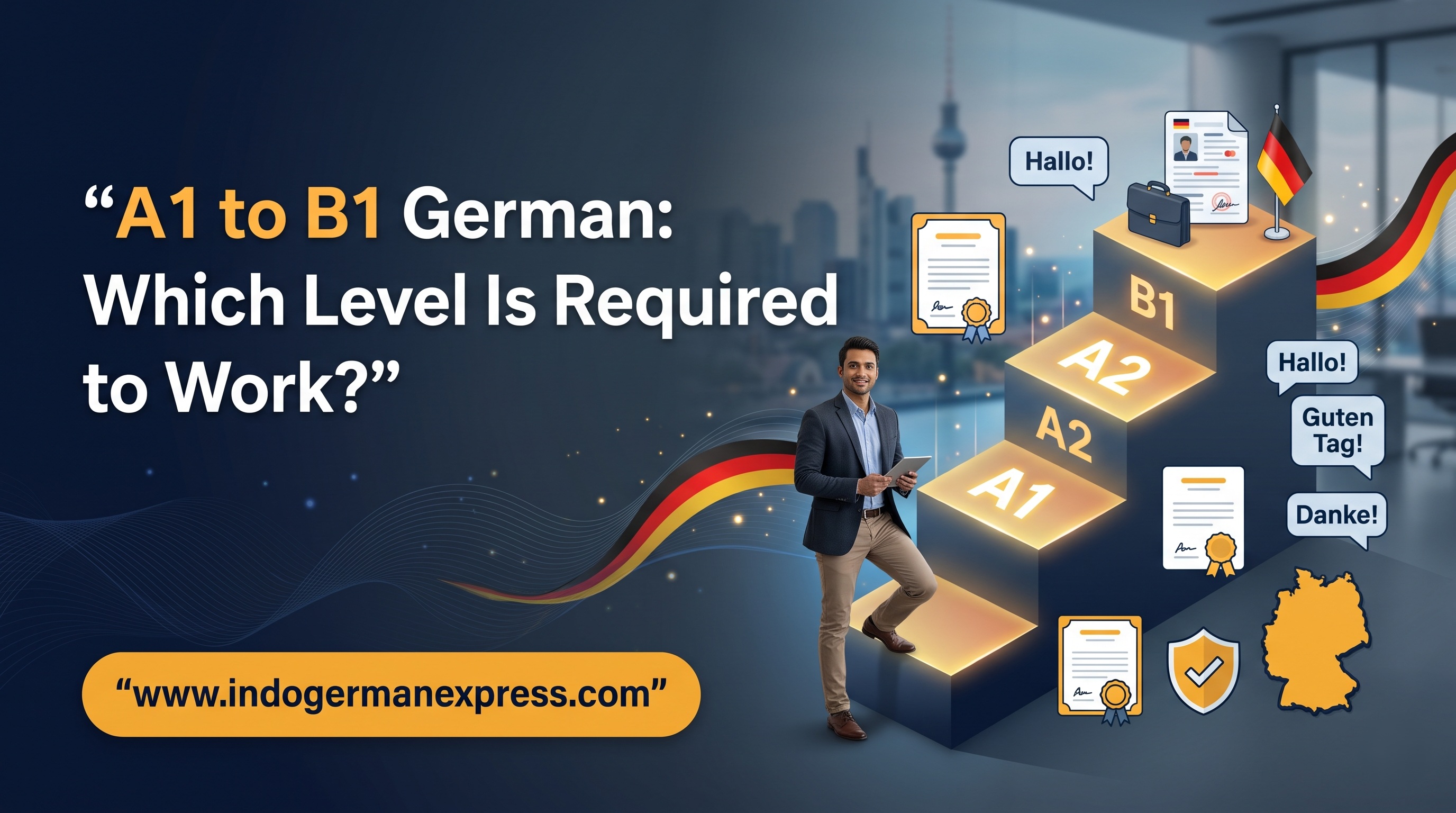
A1 to B1 German: Which Level Is Required to Work?
Discover insights and practical tips to accelerate your German language learning journey.
Germany keeps drawing international students and professionals who are seeking better career prospects, professional advancement, and experience in an international working environment. Yet for those intending to work in Germany, a frequent worry is how much German they must know before they start applying for jobs.
Perhaps you have finished A1 or A2 and are asking yourself whether your current language skills are sufficient to land a job. Or maybe you are working toward B1 and want to know whether reaching that level will boost your prospects in the German job market.
The answer varies according to your industry, the type of job, and the communication demands of the employer. Although some roles are open to English-speaking applicants, German proficiency can make a considerable difference to your employment opportunities.
Let's look at what each level provides and how far you should advance to be ready to work in Germany.
Understanding A1 German: Is It Enough to Begin Working?
A1 is the beginner stage of German. At this level, learners build the ability to understand and use simple everyday expressions, introduce themselves, ask basic questions, and share basic personal information.
For instance, you can introduce yourself to a colleague, say where you are from, ask someone's name, and follow simple instructions when they are spoken slowly.
Still, A1 is usually not enough for jobs that involve regular communication in German. You might understand basic workplace vocabulary, but taking part in meetings, dealing with customer questions, or explaining work-related problems can prove difficult.
There may be certain jobs where basic German suffices, especially when the work environment is English-speaking or the duties involve limited spoken communication. Some entry-level or temporary positions may also have more flexible language requirements. Even so, A1 should be seen as a starting point rather than a level that gives broad access to the German job market.
A2 German: Can You Handle Basic Workplace Communication?
At A2, your communication ability improves. You can understand commonly used expressions, talk about familiar topics, describe your daily routine, and exchange simple information.
In the workplace, this can help you follow basic instructions, talk with colleagues about routine tasks, and answer simple questions.
For instance, you might be able to say that you have finished an assignment, ask a colleague for basic information, or talk about your working hours. However, A2 does have its limits. You may find it hard when someone speaks fast, uses workplace vocabulary you don't know, or explains a complicated task. Dealing with unexpected situations and taking part in detailed discussions can be difficult as well.
A2 might be enough for some jobs where communication is limited and tasks are clearly defined. But for roles that involve customers, administration, teamwork, or regular contact with German-speaking colleagues, employers may expect a higher level. If you have finished A2, moving on to B1 can help you become more independent in everyday and professional communication.
B1 German: Does It Make You Job-Ready?
B1 is a key milestone, as it marks an independent level of language proficiency. At this stage, you can grasp the main points of clear conversations, communicate about familiar topics, and handle many everyday situations. In a professional setting, B1 can help you follow routine instructions, take part in straightforward workplace conversations, describe your previous experience, and communicate basic work-related needs. For example, you might be able to talk with a colleague about your daily responsibilities, explain why a task is delayed, ask for clarification, or let your manager know about a problem.
B1 can be helpful for positions where German is needed for basic communication but where complex discussions and specialised language are not central to the role.
Still, it is important to realise that B1 does not automatically make you suitable for every German-speaking workplace. You may still find it hard to take part in detailed meetings, negotiate with clients, write complex professional emails, or follow technical discussions. For many international professionals, B1 is a solid foundation, but continuing towards B2 can bring greater confidence and flexibility.
Why B2 German Can Be an Advantage in the Job Market
Although the focus is often on A1, A2, and B1, it is worth understanding why many employers mention B2 in their job advertisements. At B2, you can understand more complex texts and discussions, communicate more fluently, and express your opinions more clearly. You are also better prepared to take part in professional conversations without always relying on someone else to translate or simplify information.
This becomes especially important in roles that involve client communication, team coordination, presentations, negotiations, and making decisions independently.
For instance, an HR professional may need to conduct interviews, address employee concerns, explain company policies, and communicate with various departments. A B1 learner may handle some routine interactions, but B2 can offer a stronger foundation for managing more detailed conversations. Likewise, professionals in sales, consulting, finance, administration, and project management may benefit from being able to communicate confidently in German.
B2 is not a universal requirement for employment in Germany, but it can make you eligible for a broader range of positions where professional communication in German is expected.
Which German Level Do Different Industries Require?
The language level a job requires varies considerably from one industry and employer to another. Your professional qualifications and experience are also significant factors.
In the IT sector, English-speaking opportunities are relatively common, especially in international companies and technology startups. Some software development and data-related positions may not require German at all. However, B1 or B2 can widen your options, particularly when working with German clients or local teams.
In healthcare, German proficiency is especially important because professionals need to communicate with patients, doctors, and other medical staff. Depending on the profession and recognition requirements, higher language levels may be necessary. For regulated healthcare roles, specific language requirements must be checked separately. In customer service and sales, regular interaction with German-speaking customers makes language proficiency essential. Employers may expect B2 or higher, depending on how complex the role is.
In engineering and manufacturing, requirements differ from company to company. Technical roles in international organisations may operate in English, while positions involving production teams, suppliers, and local clients may require German.
In human resources and administration, German is often valuable because employees regularly handle recruitment, internal communication, documentation, and employee-related matters. In these roles, a B2 level or above can be especially useful. As a result, no single German level ensures employment in every industry. The most effective strategy is to review job postings in your chosen field and note the language requirements that employers frequently list.
Can You Apply for Jobs While Learning German?
Yes. You don't need to wait until you reach B2 or C1 to begin your job search.
Many international companies hire candidates on the basis of their technical expertise, academic credentials, and professional experience. If a job posting lists English as the
working language and does not state a German proficiency requirement, you may apply even if you are still at A1 or A2. Still, be truthful about your language skills. If you are currently learning German, state your actual level on your CV instead of claiming fluency.
You can also keep improving your German while you apply for jobs. This lets you gain professional experience while steadily building the language skills you will need for future opportunities.
For students in Germany, learning German alongside university studies can also help when applying for internships, Werkstudent positions, and graduate opportunities.
How to Progress from A1 to B1 for Professional Communication
Reaching B1 takes more than memorising vocabulary and completing grammar exercises. You need to develop all four language skills: listening, speaking, reading, and writing. Begin by building a solid foundation in basic sentence structures, common verbs, vocabulary, and everyday expressions at A1 and A2. After you move on to B1, focus on expressing opinions, describing experiences, explaining problems, and taking part in longer conversations.
Try to incorporate workplace-related vocabulary into your learning routine. Learn how to introduce your professional background, describe your responsibilities, ask questions about assignments, and communicate with colleagues. Practicing speaking is especially important. Even if you grasp German grammar, forming sentences quickly in a real conversation can still be a challenge. Doing speaking exercises on a regular basis can help you get past this hurdle.
Structured online classes can offer guidance as well, especially when you move from one CEFR level to the next. Indo German Express provides German language programmes that include interactive sessions, trainer support, and preparation for recognised exams such as Goethe and telc.
Conclusion
The German language level required to work in Germany depends on the kind of job you are seeking and the communication that role involves. A1 gives you a basic introduction to the language, A2 helps you handle familiar situations, and B1 lets you communicate with greater independence. However, if your aim is to open up a broader range of professional opportunities, working towards B2 can be a worthwhile decision.
You do not have to be fully fluent before you start your job search. Rather, find out what your target industry requires, keep building your language skills, and practise using German in professional settings. Learning German is a gradual process, but every level brings you closer to communicating with confidence and building a career in Germany.
Ready to Start Your German Journey?
Join thousands of students learning German with Indo German Express
Explore Our Courses