

Can I Switch Jobs While Learning German?
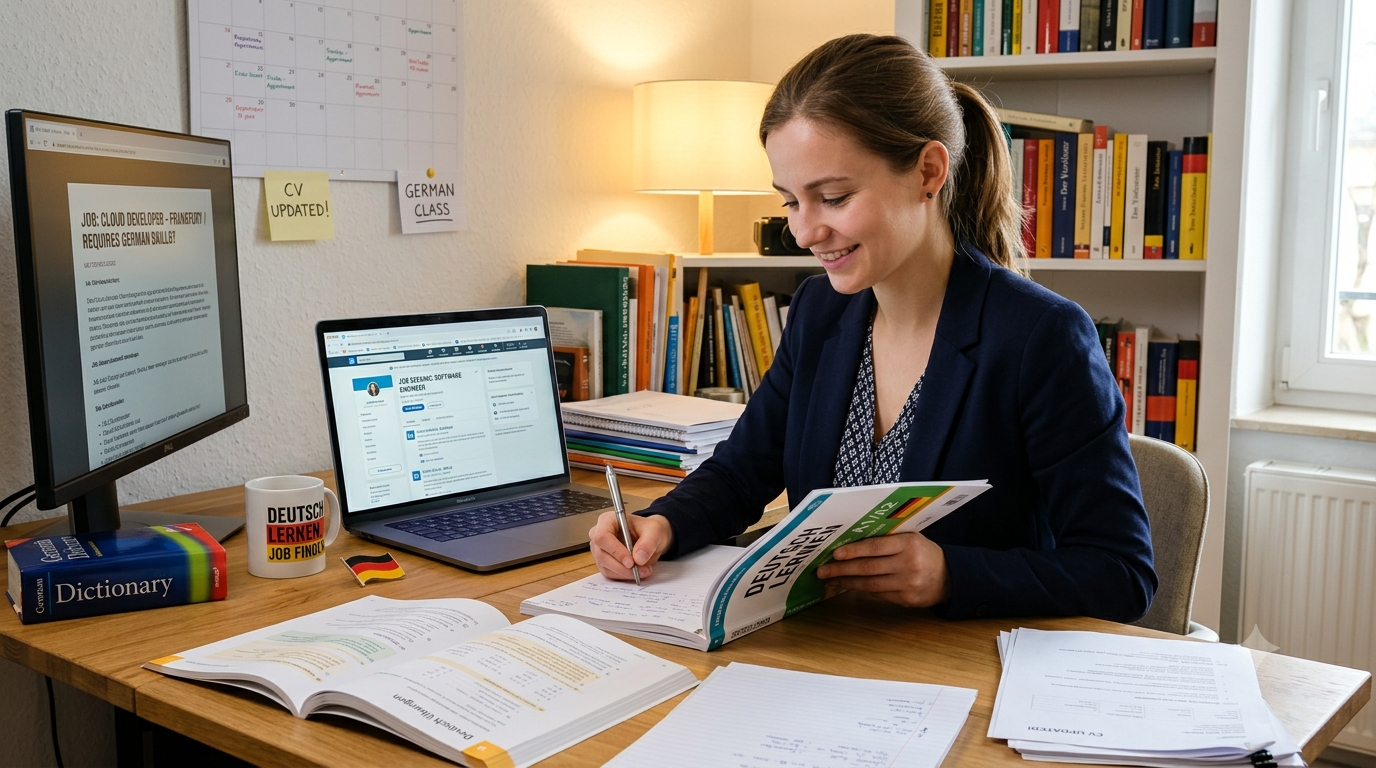
Discover insights and practical tips to accelerate your German language learning journey.
Going to Germany for work usually means having two aspirations, a career and learning German. And very often, these two aspirations appear simultaneously. And the next logical question that arises is whether one can change their job while learning the language.
And the answer to this question is affirmative. Learning German does not imply being stuck at one's job until they become fluent in the language. And sometimes, switching jobs while mastering the language becomes a part of the career development process. The main thing here is to be aware of one's employment situation and make the right plan.
Does Changing Jobs Affect Your Residence Status?
This is one of the first aspects that needs to be addressed when considering moving to a different position.
The possibility of making such a move depends on the residence permit, your employment circumstances, and the nature of your work. Different residence permits allow for different possibilities.
In case if your residence permit is tied to a particular employer or a certain job position, then switching jobs might involve some extra effort.
Thus, before accepting a new job offer, you need to familiarize yourself with the terms of your residence permit and, if necessary, consult the appropriate authorities of Germany. A job switch must be carefully thought out both in terms of professional development and administration of law.
Can I Find a Better Job Without Speaking Fluent German?
Yes, especially in industries where English is widely spoken. People working in areas like:
- Information Technology C Software development,
- Engineering,
- Data C Technology,
- Research, and
- International Business,
might find companies where German is not a necessity at all.
But the more you improve your German, the greater your choice will be. For example, an individual who knows English and German can consider applying to jobs where he/she needs to interact with people who speak German. Language study thus becomes a valuable addition to your career planning process.
Why German Can Help During a Job Search
Even without making it compulsory, German can still make a difference for your CV. German language abilities will allow you to:
- Grasp job description in German easier
- Communicate with different employers
- Excel at interviews
- Establish professional connections
- Join discussions at work more easily
In some cases, it makes a huge difference whether you speak A2, B1 or B2 German.
Should You Wait Until You are Fluent?
That is not always the case , Waiting until reaching B2 or C1 to seek for an alternative may postpone your plans unnecessarily.
On the contrary, you should take into consideration your level and the job requirements.
For instance, even when being at the A2 level and encountering a good chance to work in the English-speaking environment corresponding to your professional background, you could be a good candidate for that position. However, you should not forget about your German studies.
How to Balance a New Job with German Classes
Taking on a new job often means extra effort is required. This can make it hard to keep up with the same study schedule.
A practical timetable is better than an unpractical one which cannot be kept up. Options include:
- Attending evening or weekend classes
- Studying for a little while every day
- Using your time on the commute to listen to German audio
- Learning vocabulary during downtime
- Practicing speaking skills frequently
Online classes might be especially practical for working adults since they eliminate the need for attending the class.
What If the New Job Requires German?
If you are applying for a job that requires you to speak German, you should concentrate on the preparation even more.
Prior to the interview, you need to practice:
- Introducing yourself in German
- Talking about your experience
- Explaining your duties
- Discussing your strengths
- Answering interview questions
You do not have to be perfect in German. You just have to show that you can communicate and develop further.
Does Changing Jobs Help You Learn German?
It Can,
In the new job, you can face an environment with different vocabulary, ways of communication, and working situations. In case your new co-workers speak German, then you would definitely get more chances to practice.
For instance, you might start understanding typical phrases used in the workplace, joining conversations, or being more confident speaking German in meetings.
Nevertheless, workplace practice alone is not sufficient in many cases
What Should You Look for in Your Next Job?
In case you are Learning German and intend to switch jobs, it is advisable to weigh other factors besides compensation and job title.
These include:
- Language of communication at the firm
- Career progression potential
- International or German-speaking workforce
- Training possibilities
- Work location and commute time
- Possibilities of using German on the job
This would help you develop professionally as well as linguistically.
Can German Improve Your Career Growth?
Absolutely. As you advance in your career, you will see that language skills could be very useful.
German B1 will allow you to handle professional communication tasks in the office, whereas German B2 will give you more assurance in meetings, presentations, and discussions.
For professionals striving for management positions or dealing directly with clients, German skills might be especially important.
This is precisely why learning German should not be considered only as a must-have qualification for obtaining a first job position.
A Practical Approach for Professionals
Even though you are already in Germany and studying German, this does not mean that you have to give up either of your aspirations.
One way to go about it would be:
Work as you are → Enhance your German → Gain Experience → Find better prospects → Apply once the opportunity arises.
Through this you will be able to enhance your professional credentials and broaden your scope of available jobs.
Things to Check Before Switching
Before taking on a new job, consider the following:
- If your permit allows for a change
- If the new job qualifies as per your permit
- Your notice period
- Your contract
- Language proficiency as per the new employer’s expectations
- Your finances during the process
These considerations will go a long way in ensuring an easy transition to the new job.
Final Thoughts
Of course, you can change your job while studying German. There is no need to wait until you become a fully fluent speaker before changing your job.
It is important to find a good compromise between professional development and learning a language. If you work in an English-speaking company, you can keep your job and learn the language at the same time. As a result, with the improvement of your language skills, you will be able to get other jobs and duties.
German should not hinder you when changing your job. It can become your advantage and help you in developing professionally.
Ready to Start Your German Journey?
Join thousands of students learning German with Indo German Express
Explore Our Courses