
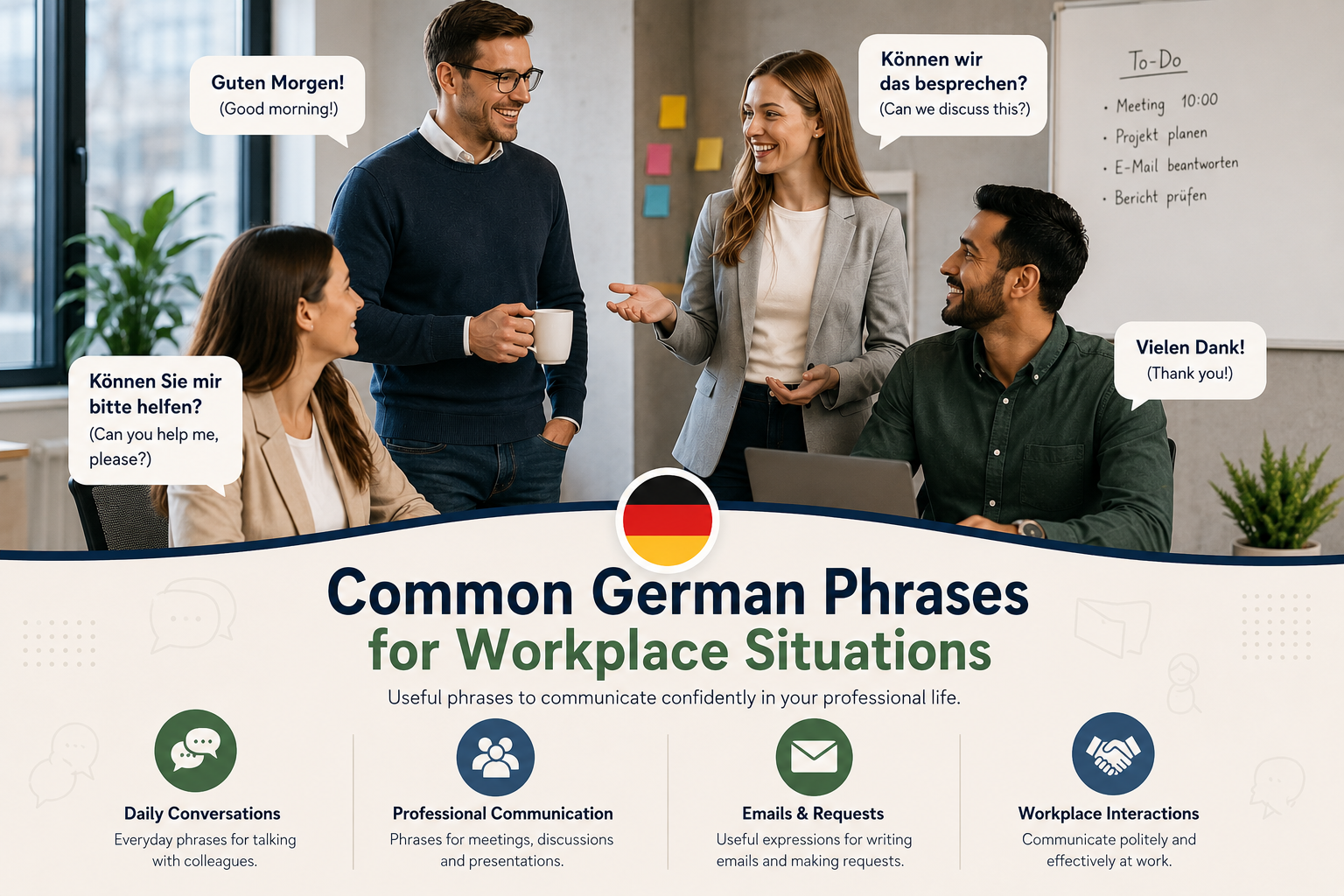
Common German Phrases for Workplace Situations
Discover insights and practical tips to accelerate your German language learning journey.
A new job opportunity in Germany is certainly exhilarating, but it may take you some time to settle down in your new place of work. For an international worker, perhaps one of the greatest difficulties in adjusting to the workplace is understanding the way that the people in it communicate.
Although the working language in your workplace may be English, you may come across German in greetings, informal conversation, in meetings, and even during your day-to-day interaction with co-workers. Knowing a few useful phrases will surely be helpful in such situations.
You don’t necessarily have to learn advanced German to begin communicating in the workplace.
1. Starting the Workday
The easiest thing to do while beginning to use German in the workplace is to greet. Useful phrases:
- Guten Morgen! – Good morning!
- Guten Tag! – Good day!
- Hallo! – Hello!
- Wie geht es Ihnen? – How are you? (Formal)
- Wie geht's? – How are you? (Informal)
One can just say "Guten Morgen!" as soon as one enters his office. It may be a little phrase but it is a natural way to begin interacting with colleagues.
2. Introducing Yourself to Colleagues
As you start your work on the team, you may need to introduce yourself more than once. Here are a few phrases that will help you do that:
- Ich heiße – My name
- Ich bin neu im Team – I am new to the team
- Ich arbeite als [Berufsbezeichnung] – I work as a
- Ich freue mich, Sie – Nice to meet you.
- Ich freue mich auf die – I look forward to working with you. Such phrases might come in handy during your first few days in the new workplace.
3. Asking Someone for Help
Asking for assistance is an integral part of the work environment. If you need to work in a foreign language, learning to do it nicely will make your life easier.
- Können Sie mir bitte helfen? – Could you please help me?
- Könnten Sie mir das bitte erklären? – Could you please explain that to me?
- Ich habe eine – I have a question.
- Könnten Sie mir bitte zeigen, wie das funktioniert? – Could you please show me how this works?
These phrases will be handy if you want to learn a new procedure or deal with something you haven’t seen before.
4. When You Do not Understand Something
You are not going to understand everything at once, especially when people talk fast and use professional terminology.
It is better to ask rather than pretend you understood everything.
- Können Sie das bitte noch einmal sagen? Can you say that again, please?
- Können Sie bitte langsamer reden? Can you please speak slowly?
- Ich habe das leider nicht I have not understood that.
- Was bedeutet das? What does that mean?
Asking questions is one of the essential skills to develop in a workplace setting.
5. During Meetings
Conversations in meetings are another instance where some German phrases would come in handy.
- Wann fängt das Meeting an? When does the meeting start?
- Können wir anfangen? Can we get started?
- Ich habe da eine
I Have a Question Regarding That.
- Ich bin einverstanden mit I agree with you.
- Ich sehe das etwas I view it differently.
- Können Sie das bitte noch mal erläutern? Would you mind explaining that again, please?
It is not necessary for you to speak German all through the meeting. It will help if you just use a few phrases in the conversation.
6. Talking About Your Work
You may also need straightforward phrases to talk about your assignments and duties.
- Ich arbeite gerade an diesem I am working on this project right now.
- Ich bin fast fertig mit der
I am Almost Done with This Assignment.
- Ich habe noch ein bisschen I still need some time.
- Ich habe die Aufgabe
I Have Completed the Assignment.
- Ich werde Ihnen die Datei später I will send you the file later.
Such expressions are especially helpful for professionals who are still developing their work vocabulary.
7. Discussing Deadlines
Deadlines are a vital component of any professional setting. You might come across terms like:
- By when do you need this? Bis wann brauchen Sie das?
- I will finish it until
Ich Werde Es Bis Freitag Fertigstellen.
- We require more time. Wir brauchen mehr
- This needs to be completed till Das ist bis morgen fertig.
8. Talking to Your Manager
Communicating with your manager will be a bit more formal. You could say:
- Haben Sie einen Moment Zeit? Do you have a moment?
- Ich würde gerne mit Ihnen über etwas I would like to speak with you about something.
- Könnten wir einen Termin vereinbaren? Could we arrange a meeting?
- Könnten Sie mir bitte Feedback geben? Could you please give me some feedback?
The use of polite expressions will make it easier for you to communicate in a professional manner while learning German.
9. Everyday Conversations with Colleagues
Communication in the workplace is not restricted to meetings and tasks. Informal conversations can also be a very good way of establishing relations with your colleagues.
You Can Hear:
- Wie war Ihr Wochenende?
- How was your weekend?
- Haben Sie schon Mittag gegessen?
- Have you eaten lunch?
- Möchten Sie einen Kaffee?
- Would you like some coffee?
- Bis später!
- Till later!
- Bis morgen!
- Till tomorrow
10. Ending the Workday
You may also use German while leaving your office.
- Ich mache It is time to leave work.
- Bis morgen! Until tomorrow!
- Schönen Abend noch! Have a good evening!
- Bis nächste Woche! Until next week!
These are basic phrases but widely used in the office environment.
Formal or Informal German at Work?
German has a distinction between formal and informal communication.
If the person you talk to is unfamiliar to you, then "Sie" is appropriate. If the person you are talking to is known to you, then "du" would be proper.
The corporate culture in different organizations differs. While in some organizations, du is used right from the start, other organizations maintain a formal style of communication.
It is always better to act like your colleagues when you are new at work.
How to Remember These Phrases
Do not attempt to memorize all the phrases in one day.
Instead, select the five or ten phrases that you will use most frequently and practice them diligently.
For instance, in the first week, pay attention to:
- Greetings
- Introduction
- Requests for assistance
- Requests to repeat
- Goodbye
Once you get used to these phrases, slowly increase the number of professional phrases.
In fact, speaking them out loud is especially helpful since you need to remember them quickly at the place of work.
Build Your German Beyond These Phrases
These expressions are a useful starting point, but they are not a substitute for broader language learning.
The more you move from A1 and A2 to B1 and B2 levels, the more comprehensible you will become in complex conversations, the more capable in describing your thoughts, and the more active in participating in professional discussion.
A systematic training will assist you in developing your base and the workplace discussions will give you an opportunity to use it.
Institutions like Indo German Express provide structured courses in the German language including grammar, vocabulary, speaking, and systematic learning.
Final Thoughts
It is not necessary to know many German phrases prior to beginning employment in Germany. Even a few practical phrases may allow you to communicate with your coworkers, to ask for help, to engage in ordinary conversations, and to feel more comfortable in your workplace.
The key point is that you should be able to apply what you have learned. Don’t be concerned about making occasional mistakes in pronunciation and grammar. Begin by learning simple phrases, apply them systematically, and increase your vocabulary incrementally. With practice, the German language spoken at work will become more familiar to you.
Ready to Start Your German Journey?
Join thousands of students learning German with Indo German Express
Explore Our Courses