

German Language Plateaus: Pushing Past Intermediate to Job-Ready
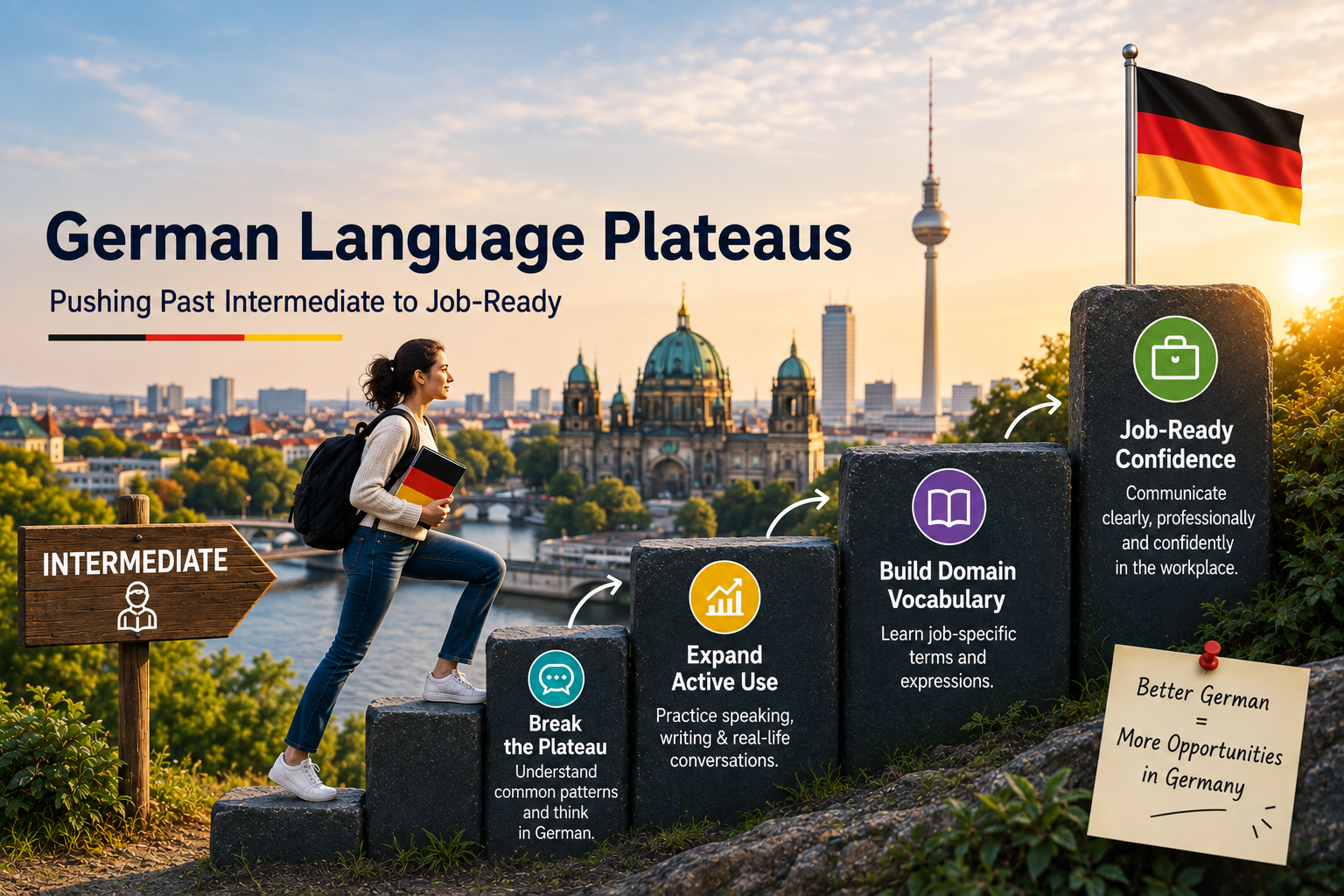
Discover insights and practical tips to accelerate your German language learning journey.
It can be a significant milestone to achieve intermediate level of the German language. It means that you understand conversations, share your point of view, communicate through emails and deal with numerous cases without the help of the English language. However, many students find this stage to be the point when their improvement stops.
You study the language on a regular basis, but its development does not progress as fast as it happened in A1 or A2 levels. You understand everything quite well, but speaking is difficult. Also, you are aware of the grammar rules, but you have troubles using them in practice during conversation.This is called a language plateau.
For those students who plan to study or work in Germany, passing this stage is essential. Your goal is not to reach B1 or B2 levels, but to become confident enough for communicating in professional environment.
What is a German Language Plateau?
A language plateau is a period when one feels that progress is slower, although the learning process continues.
In the beginning stages, learners perceive the pace of their development as fast. They learn greetings, simple vocabulary and phrases, basic sentence structure and start noticing their results.
Nevertheless, at the intermediate stage progress becomes hard to perceive. One could experience such things as follows:
- "I understand German well but cannot speak "
- "I know a lot of vocabulary but cannot recollect them when "
- "I can understand the conversation but cannot join it "
- "I keep making grammar mistakes all the "
Those are some of the signs of an intermediate plateau.
Why Does Progress Slow Down?
These are some of the reasons for experiencing this stage by learners.
You Stop Learning New Structures
In the beginner stages of learning, everything is new. But at the intermediate stage, the learner usually repeats the same grammar structures and vocabulary. It can make learning easier.
You Understand More Than You Speak
Your listening comprehension could be better than your oral skills. You could comprehend what is said in the German podcast but find it difficult to speak about the same topic.
You Use Only Known Words
While speaking, it is natural to use the words that you know. It can lead to you not building up your active vocabulary.
You Think Too Much About Making Mistakes
Some learners become afraid of making mistakes. Therefore, when speaking, the learner tends to think about the grammar of the sentence every time before using it. It makes speech slower.
The remedy is not to ignore the mistakes. It is just to develop the skill of communicating without translating each sentence in your head.
Move From Learning German to Using German
One of the most significant improvements that can be made in an intermediate level is being active in using German.
Instead of focusing only on memorizing vocabulary lists, try to incorporate new words into your conversation.
In the case of learning grammar, do not keep on repeating the explanation; instead, form your own sentences.
For instance, if you learn vocabulary concerning meetings, then practice explaining your point of view regarding a subject matter as if you are in a real office meeting.
Build Professional German Alongside General German
In case you wish to pursue your career in Germany, there is more to language learning than just studying general German.
It is important that you also build professional vocabulary.
For instance:
- Human resource experts can study vocabulary of hiring and
- Engineers may concentrate on the technical and production
- IT experts may learn project-specific terms and language used at the
- Business experts may learn vocabulary related to accounting and This way, you are building up your language skills for your professional life.
Improve Your Speaking Without Waiting for Perfection
Speech will usually be where the intermediate learner finds his greatest challenge.
A good method is to practice speaking as much as possible without attempting to get each sentence just right.
This includes:
- Talking about your day in
- Discussing your
- Describing a project that you have
- Commenting on some news
- Practicing responding to interview
- Engaging in brief conversations with other German
In the beginning, your sentences will probably not be perfect. This is perfectly natural. Your aim is to become confident about expressing your ideas.
Work on Your Listening Skills
Textbook German is easier for intermediate learners to comprehend while holding a conversation can be difficult.
People might talk faster than your learning material or use informal language and different accents.
In order to better yourself at it, surround yourself with various German. Listen to the following:
- German podcasts
- Interviews
- News clips
- Conversations at work
- German videos
It is alright if you don’t understand everything. The first step should be understanding the general meaning.
Gradually, your skills in comprehending normal conversations will get better.
Turn Passive Vocabulary into Active Vocabulary
Recognizing a word and comprehending it when reading is not the same thing as using it when talking. This forms the distinction between passive and active vocabulary.
Even if you already know a certain word but hardly ever use it, you need to begin incorporating it into your speech. For instance, try learning one or two words per week and actually using them.
Use German at Work Whenever Possible
If you have been working in Germany for some time, your place of work will be an ideal learning platform.
This can begin with a few small steps, which include:
- Greets to your colleagues in German
- Simple conversations
- Writing short messages in German
- Posing simple questions
- Taking part in discussions attentively
You are not required to change to using only German immediately.
Prepare for Job Interviews
In case your aim is to make yourself job ready, then interview practice is an important part of your language learning exercise.
It would be helpful to practice:
- Education
- Work experience
- Responsibilities
- Professional accomplishments
- Strengths
- Career goals
It will also be useful to answer questions that you have not prepared for, rather than having answers by heart. This will make you comfortable speaking German spontaneously.
Get Feedback Instead of Guessing
One of the reasons why learners get trapped at the intermediate stage is due to their repeated errors.
If there is no one correcting these errors, then the learners may end up forming a habit of making the same mistakes.
A trainer or experienced person in the language can be of great help in recognizing:
- Grammar errors
- Pronunciation errors
- Vocabulary usage errors
- Sentence structuring
The areas that require communication to be improved
Formal classes can be helpful for learners at this stage since they do not have to recognize the problems on their own.
Set a Specific Goal
Improvement of my German language skills is a general goal. It would be better to define a particular goal.
For Instance:
"Learning German up to B2 level and conducting a German job interview with confidence."
With a clearly defined goal, it will become possible to arrange your studies according to it. This goal will allow for using professional vocabulary, questions that can be asked in an interview, speaking and listening exercises, etc.
How Long Does it Take to Move Beyond the Plateau?
There is no set schedule for that , it really depends on your current proficiency, your study habits, how much you are exposed to the German language, and how much speaking practice you get.
The key here is consistency , So long as you are consistent in actively using German instead of simply studying it, you will see progress. Job proficiency in the German language does not mean sudden fluency in it.
Final Thoughts
A language plateau does not mean that one stops learning. Language plateaus are quite common and could be a phase during which learners progress to advance from the basics of the language. The crucial thing is to alter the approach towards learning.
Practice talking in German more often, listen to authentic German speakers, learn the professional terminology, apply the new terms in everyday speech, and receive feedback. The most important advice is never to postpone using German until the language reaches perfection.
Moving from intermediate level of German for those who would like to work in Germany provides additional chances and helps overcome many barriers on the way. The basis is already built. Now it is necessary to turn knowledge into practical language skills.
Ready to Start Your German Journey?
Join thousands of students learning German with Indo German Express
Explore Our Courses