
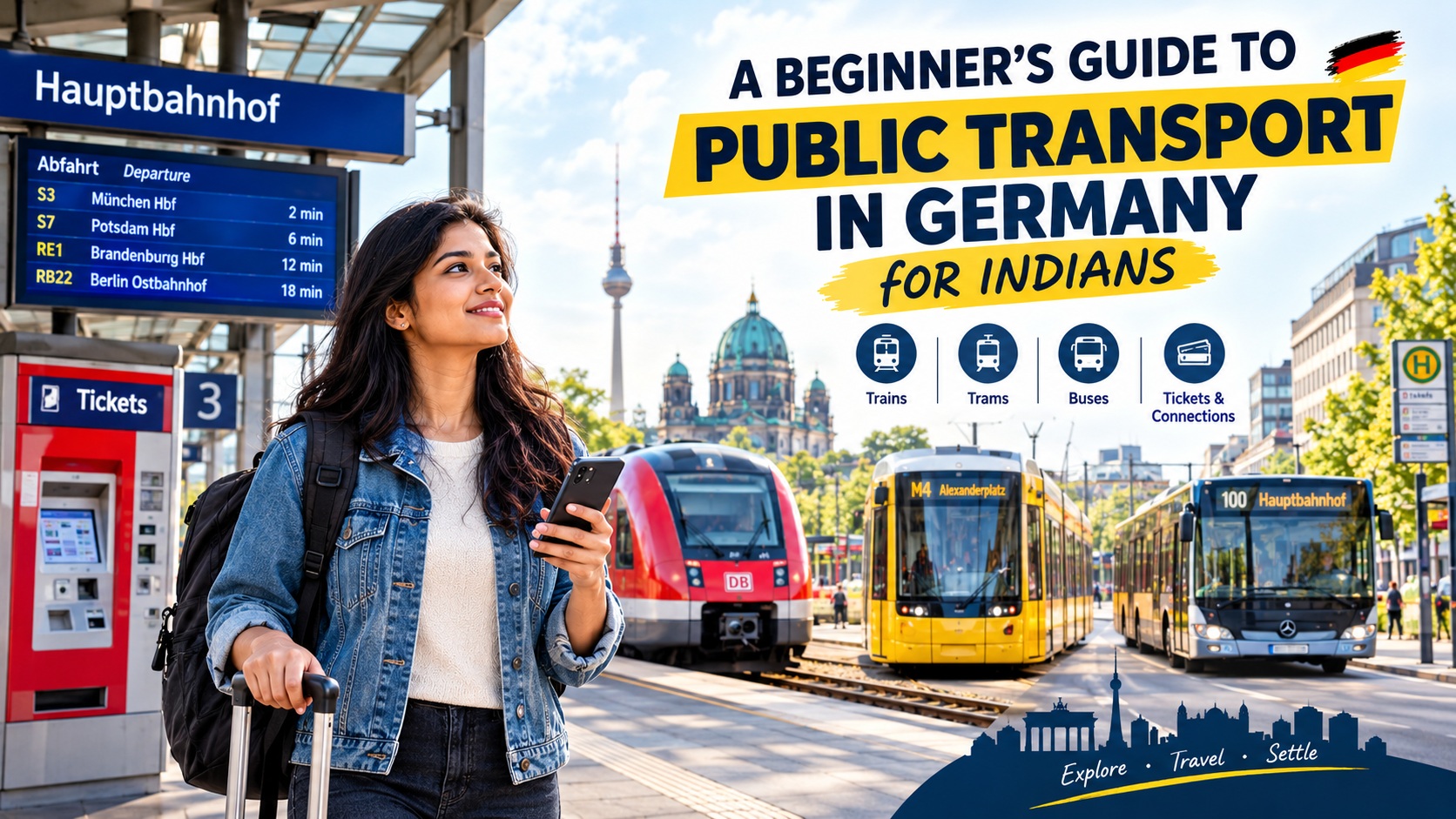
A Beginner's Guide to Public Transport in Germany for Indians
Discover insights and practical tips to accelerate your German language learning journey.
Public transport is one of the first things that the Indians need to learn about after relocating to Germany. It is unlike other Indian cities where individuals may use autos, cabs, or even public or private transport. The day-to-day living of Germans relies on the use of buses, trains, and even tram ways.
The process of comprehending how the public transport in Germany operates might be complicated owing to the several types of trains available in the country, regional transport, various kinds of tickets, and applications. Once one is familiar with the basics, traveling both within the city and Germany will be easier.
Below is a guide for the Indians.
1. Understand the Different Types of Public Transport
Germany has a number of types of public transport which you might use in your day-to-day life.
U-Bahn
U-Bahn is the underground metro system that is mostly found in big cities like Berlin, Munich, Frankfurt, Hamburg, and Cologne. This type of transport is convenient for traveling within the city and operates quite often.
S-Bahn
S-Bahn is the suburban railway system that links the city center to outer areas and is especially convenient if you live in the suburbs. Although the S-Bahn has 'underground' in its name, trains operate partially above the ground.
Tram
Trams run either on roads or special tracks and can be found in almost all German cities. This is especially convenient for traveling within cities.
Bus
Buses connect neighbourhoods which do not have any train or tram transport and are especially convenient for traveling to your university, accommodation, shopping centers, or stations.
Regional Train
Regional trains are convenient when traveling from one town or city to another. Common abbreviations include:
- RB - Regionalbahn
- RE – Regional-Express
- S-Bahn - suburban railway
Remember, however, that it is different from long-distance train travel in Germany.
2. What is the Deutschlandticket?
Deutschlandticket is the ticket that is very helpful to students and residents.
The price for it as of 2026 is €63 per month, providing access to free rides on all local and regional public transport within Germany. These include buses, trams, U-Bahn, S-Bahn and regional trains (RB and RE). It is quite handy for people using public transport often.
However, there is one thing you should know about it: the Deutschlandticket is not normally valid on long-distance trains (ICE, IC and EC) and services provided by companies like FlixTrain.
Therefore, if you are traveling between German cities, make sure what train you are taking.
3. Deutschlandticket Does Not Mean Every Train is Free
This is probably the most frequent mistake that beginners can make.
For example, you need to travel from Berlin to Munich. This trip could include an intercity train via ICE. But Deutschlandticket usually does not include this ICE trip. But if you travel by regional trains, then this ticket will be suitable for the trip, but it will last much longer.
Thus, while looking for a route, pay attention to the type of train - whether it is ICE/IC/EC or regional trains.
If you use the Deutschlandticket and do not want to pay additionally, then look for the local/regional connections.
4. Download the DB Navigator App
DB Navigator is one of the best apps that you should have while residing in Germany.
This app may assist you in finding links related to trains, buses, trams, U-Bahn, and S-Bahn. This app can also provide details related to departure times, connections, delays, and platform changes.
Prior to stepping out of the house, type your location and destination and verify:
- Departure time
- Platform
- Train number
- Number of changes
- Arrival time
- Delay possibilities
For a newcomer in Germany, this can really make things easier for him/her.
5. Learn How to Read a German Train Connection
Journey might appear complex since there can be a lot of changes in the app. For instance:
Home - Bus - S-Bahn - Regional Train - University
This does not imply that the journey is necessarily going to be hard. You would be provided with information on where you need to change trains, how much time you will have and what platform to use for changing. It is important to pay attention not only to the destination station but also to the direction in which the train goes.
You might miss it if you did not understand the right direction.
6. Always Check Your Ticket
The ticket rules vary based on transport and local networks. While some local tickets have to be bought beforehand, there might also be certain validation rules for certain tickets depending on transport authorities.
In case you use an electronic ticket, ensure you can access it on your phone. As per the official guidance provided by Deutsche Bahn, some tickets like the Deutschlandticket are meant to be used as mobile phone tickets, and hence, the screenshot of the ticket cannot be considered valid.
Do not consider taking a screenshot of your ticket to be enough.
7. Carry Identification With Your Deutschlandticket
Deutschlandticket is personalized and cannot be easily transferred to another person. If there is a ticket inspection, you might have to produce your photo identity alongside the ticket.
In case of Indian students, it is essential that your ticket matches the details on your identity cards.
8. What Happens During a Ticket Check?
The ticket check may take place both on trains and other types of transportation. The inspector might request a ticket. In case you use a digital ticket, show it using your mobile phone.
In case of absence of a valid ticket when it is needed, you may be subject to penalties. It is therefore better to be aware of ticket conditions in advance. In case you are not sure whether your ticket is valid for a certain trip, make sure about it in advance.
9. Punctuality is Important, But Delays Can Happen
Germany has an excellent record of punctuality in its public transport system, but this does not guarantee that trains and buses are always on time.
Delays, cancellations, constructions, and alterations can occur. This becomes relevant especially when you have:
- An examination
- An interview
- A medical appointment
- A class at university
- A flight to catch
In case of such appointments, you should never plan your connection in such a way that you have no extra time left. When your application tells you about an alteration of the connection, you should check the alternate route.
10. Give Yourself Time for Transfers
If you have not travelled on the German public transport system before, then do not pick your journey based purely on the fact that it is the quickest route. A connection of just five minutes might be problematic if you have to move to another platform or section of the station.
In the beginning, it is best to pick journeys that give you some extra time at each connection point. You will become quicker once you learn the stations and routes.
11. Public Transport Etiquette
There are some basics of public transportation etiquette that one needs to know about in Germany.
It is important to make sure that the noise level is not too loud, especially in the trains. Try not to obstruct the path for other passengers leaving the transport. If you have a big backpack, pay attention to other passengers around you. In case of a crowded bus or train, try to go further from the door and not to stand right next to it.
The seats marked for the elderly, pregnant or the disabled persons should be offered to those passengers who need them.
12. Travelling With Luggage
If you travel to another city, particularly during university breaks, chances are you will be carrying a suitcase or a big backpack.
Try to keep your luggage out of the way, such that it is not in the middle of the aisle or blocking any doorways. Should you be travelling with many pieces of luggage, give yourself enough time for a train transfer.
13. Public Transport Can Take You Beyond Your City
One of the key advantages of Germany’s transportation system is that you do not have to own a vehicle to explore the country. With the Deutschlandticket, you can travel by eligible public transport systems in Germany, including the regional trains available in various parts of Germany.
It is now possible to travel to regional destinations without purchasing separate tickets each time you travel. On the other hand, if your trip is far away and speed is your top priority, you will find the ICE more favourable than the regional transport system.
Make Public Transport Part of Your Routine
Public transport in Germany might seem confusing at first for a few days; especially if you do not know about the types of trains and ticketing system in Germany. But as you travel more in Germany, checking the routes will eventually become a routine activity in your life.
The most effective way for Indian students and professionals would be to begin with the routes they have to travel frequently, for example, from home to college, office or grocery store and then traveling to any other place in Germany becomes very easy after that. Just keep the DB Navigator app on your phone, know what is covered in your ticket, check your connection before you leave and give yourself some buffer time if you don't know the route.
With some practice, Germany’s public transport can become one of the easiest things in your day to day life.
Ready to Start Your German Journey?
Join thousands of students learning German with Indo German Express
Explore Our Courses